
Introduction
Yoga is essentially a spiritual discipline grounded in a subtle and profound science, focusing on creating harmony between the body and mind. It is both an art and a science of healthy living. The word Yoga is derived from the Sanskrit root “Yuj”, meaning to join, yoke, or unite. According to yogic philosophy, yoga is the process through which individual consciousness unites with Universal Consciousness, symbolizing harmony between mind and body, human beings and nature.
Modern scientific perspectives also resonate with this view, suggesting that the universe is a manifestation of a single quantum reality. One who experiences this oneness is said to be established in yoga and is called a yogi, having attained a state of freedom known as moksha, nirvana, or kaivalya. Thus, the ultimate aim of yoga is self-realization, overcoming suffering and attaining liberation while living a life of health, harmony, and inner freedom.
Yoga is also an inner science that offers diverse methods for self-mastery and conscious living. Considered an immortal cultural heritage of the Indus–Saraswati Valley Civilization (c. 2700 BCE), yoga has consistently contributed to both material and spiritual upliftment of humanity. Basic humane values form the core identity of Yoga Sadhana.
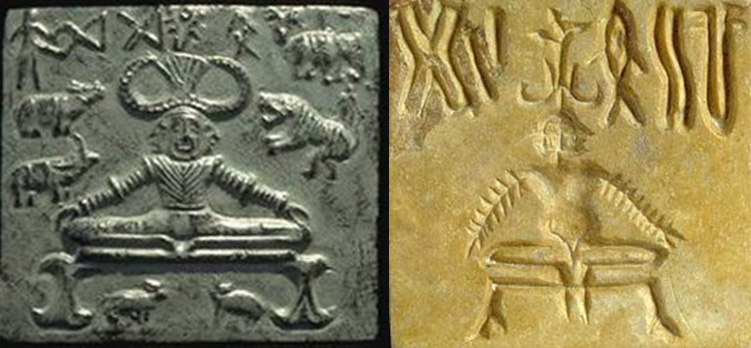
Seals from the Indus Valley Civilization (2500–1900 BCE), particularly the “Pashupati seal” found at Mohenjo-daro, feature figures in advanced yogic postures, suggesting an early origin for yoga. The primary asana identified is a seated, cross-legged position resembling Mulabandhasana or Padmasana (lotus pose), where the figure sits on a throne with heels touching. Mulabandhasana/Seated Pose: The figure is often interpreted as sitting in a “yogi” posture (often called Mulabandhasana), a squatting pose with heels joined. Some interpretations suggest the posture shows the feet placed sole-to-sole.
Pashupati Seal (Proto-Shiva): The most famous seal displays a three-faced, horned deity surrounded by animals (elephant, tiger, buffalo, rhinoceros) in a seated meditative pose. This figure is believed to be a “proto-Shiva” or “Lord of Beasts”.
A Brief History and Development of Yoga
The practice of yoga is believed to have originated with the dawn of human civilization, long before formal religions or belief systems emerged. In yogic tradition, Shiva is revered as the first yogi (Adiyogi) and the first guru (Adi Guru).
Thousands of years ago, on the banks of Lake Kantisarovar in the Himalayas, Adiyogi transmitted yogic wisdom to the Saptarishis (seven sages). These sages carried the yogic science across different regions of the world. Among them, Agastya played a crucial role in shaping the yogic culture throughout the Indian subcontinent.
Archaeological evidence from the Indus–Saraswati Valley Civilization—including seals, idols, and figures depicting yogic postures—clearly indicates the presence of yoga in ancient India. Symbols associated with fertility and the Mother Goddess suggest early Tantric practices. Yoga’s presence is also evident in folk traditions, Vedic and Upanishadic literature, Buddhist and Jain teachings, Indian philosophies (Darshanas), epics like the Mahabharata and Ramayana, Shaiva, Vaishnava, and Tantric traditions.
During this early phase, yoga was practiced under the direct guidance of gurus, and spiritual realization was considered more important than physical perfection. Yoga was deeply integrated into ritual worship (upasana). The Sun held supreme importance in the Vedic age, which may have later inspired the practice of Surya Namaskara. Pranayama was part of daily rituals, especially during sacrificial offerings.
Vedic Period
The Vedic period represents the earliest documented phase of yoga. The four Vedas—Ṛg, Yajur, Sama, and Atharva—contain philosophical insights, rituals, chants, and worldly wisdom. During this period, yoga was viewed as a path of spiritual attainment.
Three primary yogic approaches were prominent:
- Mantra Yoga, emphasizing the transformative power of sacred sound
- Prāṇa Yoga, focusing on regulation of vital energy through breath
- Dhyāna Yoga, rooted in intellect (dhī), characterized by sustained awareness, effortlessness, and inner expansion
Pre-Classical Yoga
Yoga developed further during the pre-classical period, especially through the Upanishads, which explored self-knowledge and transcendence. This era culminated in the philosophical synthesis found in the Bhagavad Gita, which emphasized sacrifice of ego rather than ritual offerings.
The Gita presented three universal paths:
- Bhakti Yoga – devotion and love
- Jnana Yoga – wisdom and self-inquiry
- Karma Yoga – selfless action
These paths demonstrated that enlightenment is attainable by all, regardless of social status.
Classical Yoga
The classical period (approximately 500 BCE – 800 CE) is considered the most systematic and fertile phase in yogic history. Though yoga existed earlier, Maharshi Patanjali codified yogic philosophy in the Yoga Sutras, organizing existing practices into a structured system.
Patanjali described the eightfold path (Ashtanga Yoga)—Yama, Niyama, Asana, Pranayama, Pratyahara, Dharana, Dhyana, and Samadhi—aimed at mastery of body and mind to attain liberation. The authoritative commentary by Vyasa further clarified these teachings.
This period also witnessed major contributions from Mahavira and Gautama Buddha, whose teachings on ethical discipline and meditation closely aligned with yogic principles.
Post-Classical Yoga
Several centuries after the classical period, yogic masters shifted their focus toward rejuvenating the body to support spiritual growth and longevity. They developed Tantra Yoga, which emphasized purification of both body and mind through innovative techniques.
Tantra Yoga
Tantric yogis believed that the body is not an obstacle to spiritual realization but a means to attain it. Tantra focuses on balancing opposing energies—masculine and feminine, internal and external, hot and cold. Contrary to common misconceptions, Tantra is not centered on indulgence but on integration and unity with the divine.
Yoga in Medieval Times
By the 6th century CE, as Buddhism declined in India, influential yogic traditions emerged. During this period, Hatha Yoga texts were composed, integrating yoga with Ayurveda and other spiritual sciences. The Natha Sampradaya developed during this era and emphasized deep meditative absorption (samadhi) as a means of liberation.
Hatha Yoga
Hatha Yoga evolved from Tantric practices and focused on caring for and strengthening the physical body. Yogis closely observed nature and animal movements, adopting postures inspired by them—such as stretching like animals or standing firm like trees. This marked the development of physical postures (asanas) as a core aspect of yoga. Hatha Yoga primarily emphasizes bodily purification, posture, breath control, and energy balance.
Between 800 CE and 1700 CE, yoga evolved through the teachings of great philosophers and saints. The Bhakti movement flourished, emphasizing devotion and surrender. Simultaneously, Hatha Yoga developed through the Nath tradition.
Great yogis such as Matsyendranatha and Gorakshanatha popularized practices focusing on bodily purification and energy awakening. Texts like Hatha Yoga Pradipika and Gheranda Samhita emerged, outlining structured physical and energetic practices.
Modern Period
From the late 19th century onward, yoga entered the global stage. Visionaries such as Swami Vivekananda introduced yoga to the West, emphasizing its philosophical depth. The 20th century saw widespread revival and scientific exploration of yoga through teachers like Sri Aurobindo, T. Krishnamacharya, and others.
Different yogic systems—Raja Yoga, Bhakti Yoga, Vedanta, and Hatha Yoga—flourished during this period, making yoga accessible for health, self-development, and spiritual growth.
Development and Significance of Yoga
In contemporary times, yoga is universally accepted as a powerful tool for health promotion, disease prevention, and holistic well-being. Yoga harmonizes the individual with the cosmos and integrates physical, mental, emotional, and spiritual dimensions of life.
Various schools such as Jnana Yoga, Bhakti Yoga, Karma Yoga, Raja Yoga, Hatha Yoga, Kundalini Yoga, Mantra Yoga, Jain Yoga, and Buddhist Yoga continue to guide practitioners toward the common goal of self-realization.
Yogic practices—including Yama, Niyama, Asana, Pranayama, Pratyahara, Dharana, Dhyana, Samadhi, Bandhas, Mudras, Shat-karmas, mantra japa, and disciplined lifestyle—collectively promote health, awareness, and inner transformation.
Ultimately, yoga is far more than physical exercise. It is a profound philosophical path encouraging self-discovery, conscious living, and realization of truth—not through blind belief, but through direct experience.
🌿 Admissions Open – YCB Level Yoga Teacher and Evaluator Coaching Classes 🌿Want to teach yoga professionally or open your own centre?
Here’s your chance to become a Govt. Certified Yoga Instructor under the Yoga Certification Board (YCB), Ministry of AYUSH, Govt. of India.
📌 Course Details:
⏰ Time: 8:00 – 9:00 PM
💻 Online Mode (Zoom – Live Theory & Practical)
✨ Benefits:
✅ Employment eligibility in schools & colleges 🏫
✅ Opportunities in India & abroad 🌍
✅ Learn with expert faculty 👩🏫
✅ Organized study materials & mock tests 📘
✅ Govt. recognized certificate 🎓
📞 Contact: 8110068073 / 9543179499
📲 Limited seats – Apply Now!
📥 Register Now: 👉 https://forms.gle/qWZmnDejHyNCXNfK7
Payment link: https://rzp.io/rzp/N2s8sPW9
🚀 Step into a successful career in yoga with Krish Yoga Vidhyaalaya (Associate Centre of IYA).
