
Yoga is essentially a spiritual discipline based on an extremely subtle science, focusing on harmony between the body, mind, and inner consciousness. Moreover, it is both an art and science of healthy living. The word Yoga is derived from the Sanskrit root “Yuj,” meaning to join, unite, or yoke. According to yogic philosophy, yoga leads the practitioner toward self-realization and liberation (Moksha).
Over centuries, various schools of yoga philosophy evolved to address different human temperaments. Although their methods vary, the ultimate aim remains the same—union of the individual soul with universal consciousness. Among them, Jnana Yoga, Bhakti Yoga, Karma Yoga, Patanjali Yoga, and Hatha Yoga are regarded as the major classical paths.
Jnana Yoga – The Path of Knowledge and Self-Realization (Elaborated)
Jnana Yoga is the path of wisdom, inquiry, and direct knowledge of the Self. It is considered the most subtle and intellectually demanding path, as ignorance (Avidya) is removed through right understanding. In this system, liberation is attained not through rituals or emotions, but through realization of truth.
Fundamentally, Jnana Yoga teaches that the individual self (Atman) and the universal reality (Brahman) are one and the same. However, this truth remains hidden due to ignorance and misidentification with the body and mind. Therefore, systematic inquiry is emphasized.
The practice of Jnana Yoga is traditionally structured into three progressive stages:
1. Śravaṇa (Listening)
At this stage, the aspirant listens to the teachings of the Upanishads, Bhagavad Gita, and Vedantic texts under the guidance of a competent teacher. The non-dual truth is introduced, and philosophical foundations are laid.
2. Manana (Reflection)
Next, logical reasoning and contemplation are applied to remove doubts. Through analysis, contradictions are resolved, and clarity is achieved. As a result, intellectual conviction becomes firm.
3. Nididhyāsana (Deep Meditation)
Finally, sustained meditation on the truth is practiced until direct experiential knowledge arises. The false sense of individuality dissolves, and Self-realization is attained.
Jnana Yoga also emphasizes four essential qualifications (Sadhana Chatushtaya):
- Viveka – discrimination between the real and unreal
- Vairagya – detachment from worldly pleasures
- Shat Sampat – six mental disciplines
- Mumukshutva – intense desire for liberation
Thus, Jnana Yoga is ideally suited for seekers with a sharp intellect, strong dispassion, and contemplative nature.
Bhakti Yoga – The Path of Devotion and Navavidha Bhakti
Bhakti Yoga is the path of devotion, surrender, and divine love, where emotional energy is transformed into spiritual power. Instead of suppressing emotions, they are refined and directed toward the Divine. Consequently, the heart becomes purified, and ego gradually dissolves.
A central concept in Bhakti Yoga is Navavidha Bhakti, the nine classical modes of devotion, described in the Bhagavata Purana. These practices allow individuals to express devotion according to their emotional temperament.
Navavidha Bhakti (Nine Forms of Devotion)
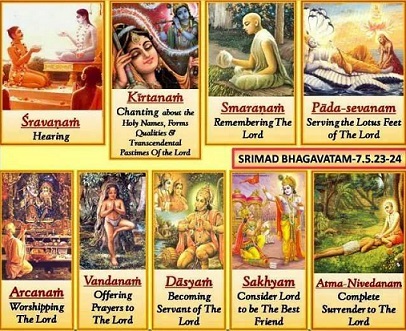
- Śravaṇam – Listening to the divine glories
- Kīrtanam – Singing or chanting the divine names
- Smaranam – Constant remembrance of the Divine
- Pāda Sevanam – Serving the divine feet
- Archanam – Ritual worship
- Vandanam – Offering prayers and salutations
- Dāsyam – Cultivating the attitude of a servant
- Sakhyam – Developing friendship with the Divine
- Ātma Nivedanam – Complete self-surrender
Through these forms, devotion matures from external worship to total inner surrender. Ultimately, love itself becomes liberation. Therefore, Bhakti Yoga is particularly suitable for emotionally expressive and faith-oriented practitioners.
Karma Yoga – The Path of Selfless Action
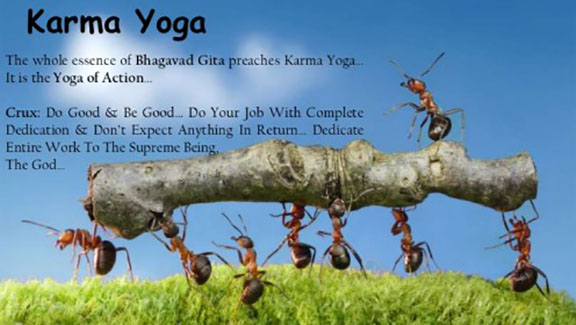
Karma Yoga teaches that right action performed without attachment leads to freedom. Every action becomes yoga when it is done as an offering, without expectation of reward. In this approach, purification of the mind is achieved through selfless service.
Importantly, bondage is created not by action, but by attachment to its results. Hence, when duties are performed with awareness and surrender, inner growth occurs naturally. This path is best suited for active individuals engaged in social and professional life.
Patanjali Yoga – The Eightfold Path (Ashtanga Yoga)
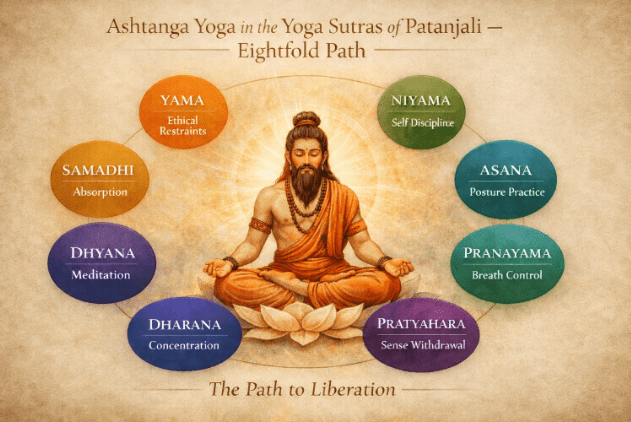
Patanjali Yoga, also known as Raja Yoga or Ashtanga Yoga, presents a systematic and scientific framework for mastering the mind. It is codified in the Yoga Sutras by Patanjali, which serve as a foundational text for classical yoga philosophy.
This school defines yoga as “Chitta Vritti Nirodhah”—the cessation of fluctuations of the mind. To achieve this state, an eight-limbed path is prescribed:
- Yama – ethical restraints
- Niyama – personal observances
- Asana – stable posture
- Pranayama – regulation of breath
- Pratyahara – withdrawal of senses
- Dharana – concentration
- Dhyana – meditation
- Samadhi – complete absorption
Through consistent practice, mental discipline is developed, and higher states of consciousness are attained. Therefore, Patanjali Yoga is suitable for serious practitioners seeking psychological and spiritual mastery.
Hatha Yoga – The Path of Physical and Energetic Purification
Hatha Yoga is one of the most widely practiced forms of yoga today. It focuses on preparing the body and energy system as a foundation for higher spiritual practices. The word Hatha symbolizes the balance of Ha (sun energy) and Tha (moon energy) within the body.
This system includes:
- Shatkarma (cleansing techniques)
- Asanas (physical postures)
- Pranayama (breath control)
- Mudras and Bandhas (energy locks)
Through regular practice, the body is purified, flexibility is improved, and vitality is enhanced. As a result, meditation becomes more stable and effortless. Hatha Yoga is particularly beneficial for beginners and wellness-oriented practitioners.ha Yoga forms the foundation for modern yoga practice and therapeutic applications.
🌿 Admissions Open – YCB Level Yoga Teacher and Evaluator Coaching Classes 🌿
Want to teach yoga professionally or open your own centre?
Here’s your chance to become a Govt. Certified Yoga Instructor under the Yoga Certification Board (YCB), Ministry of AYUSH, Govt. of India.
📌 Course Details:
⏰ Time: 8:00 – 9:00 PM
💻 Online Mode (Zoom – Live Theory & Practical)
✨ Benefits:
✅ Employment eligibility in schools & colleges 🏫
✅ Opportunities in India & abroad 🌍
✅ Learn with expert faculty 👩🏫
✅ Organized study materials & mock tests 📘
✅ Govt. recognized certificate 🎓
📞 Contact: 8110068073 / 9543179499
📲 Limited seats – Apply Now!
📥 Register Now:
👉 https://forms.gle/qWZmnDejHyNCXNfK7
🚀 Step into a successful career in yoga with Krish Yoga Vidhyaalaya (Associate Centre of IYA).
